.png)
How AI is Redefining Marketing and Sales


Most companies are not losing ground because they lack data. They are losing ground because they cannot move fast enough with the data they already have.
AI is changing that. Not in theory, in practice, and at pace. The question for senior leadership is no longer whether AI belongs in commercial strategy. It is whether your organisation is building the right foundations to benefit from it.

The Shift That Is Already Happening
AI adoption in sales and marketing is not a future trend. It is a current competitive divide.
Companies using AI in their commercial functions are reporting stronger lead conversion, faster campaign cycles, and more effective customer engagement. The gap between those organisations and the ones still deciding whether to invest is widening.
Three shifts are happening simultaneously:
• Customer data has grown faster than human capacity to analyse it.
• Buyer behaviour is more fragmented across channels and harder to predict manually.
• Speed-to-market is now a commercial advantage in itself.
AI addresses all three. It does not replace commercial judgement. It gives teams the information and speed to act on it.
What AI-Driven Marketing Delivers
When AI is embedded into specific workflows, the results are measurable:
Generalist AI tools produce generalist results. The organisations seeing the clearest returns are applying AI to specific commercial problems. Here is where it matters most.
1. Lead Prioritisation
Sales teams spend a significant portion of their time on prospects that will not convert. AI models that analyse behavioural and firmographic data can identify which leads are most likely to close, and when.
The commercial impact is direct: fewer wasted calls, faster pipeline movement, and sales effort concentrated where it is most likely to produce revenue.
2. Personalisation at Scale
Personalisation has always driven better engagement. The barrier has been the time required to do it well.
AI removes that barrier. It allows marketing teams to deliver relevant messaging across large audiences without the manual overhead. Email sequences, ad content, and product recommendations can all adjust dynamically based on individual customer behaviour, without individual human effort for each.
3. Predictive Analytics
The most valuable insight in sales is not what happened, it is what is likely to happen next. Predictive models flag churn risk before customers disengage, identify cross-sell opportunities before the window closes, and surface demand patterns before they become obvious.
Organisations that act on leading indicators rather than lagging ones consistently outperform those that react.
4. Content Production
AI does not replace good writers. It removes the bottleneck between having a message and getting it to market.
Teams can produce more variations, test faster, localise at scale, and maintain quality without proportional increases in headcount. Time-to-market for campaigns compresses. Creative effectiveness improves because teams can test and iterate rather than commit to a single execution.
5. Customer Service Intelligence
Service is a revenue function. It directly shapes retention, reputation, and repeat purchase.
AI in customer service, through intelligent routing, sentiment detection, and self-service tools, reduces resolution time and improves consistency. When service interactions are handled well at scale, the downstream impact on retention is measurable.
6. Revenue Attribution
Marketing has always struggled to prove its commercial contribution with precision. AI-powered attribution models analyse multi-channel data to show which activities are actually driving conversions, not just which ones are receiving credit.
This matters for budget decisions. Resources can be directed to what works, rather than distributed based on assumption.
The organisations seeing the clearest returns are not using AI broadly. They are applying it to specific problems with clear commercial stakes.
What Gets in the Way
The barriers to AI adoption are real. Acknowledging them is not pessimism, it is the first step to addressing them.
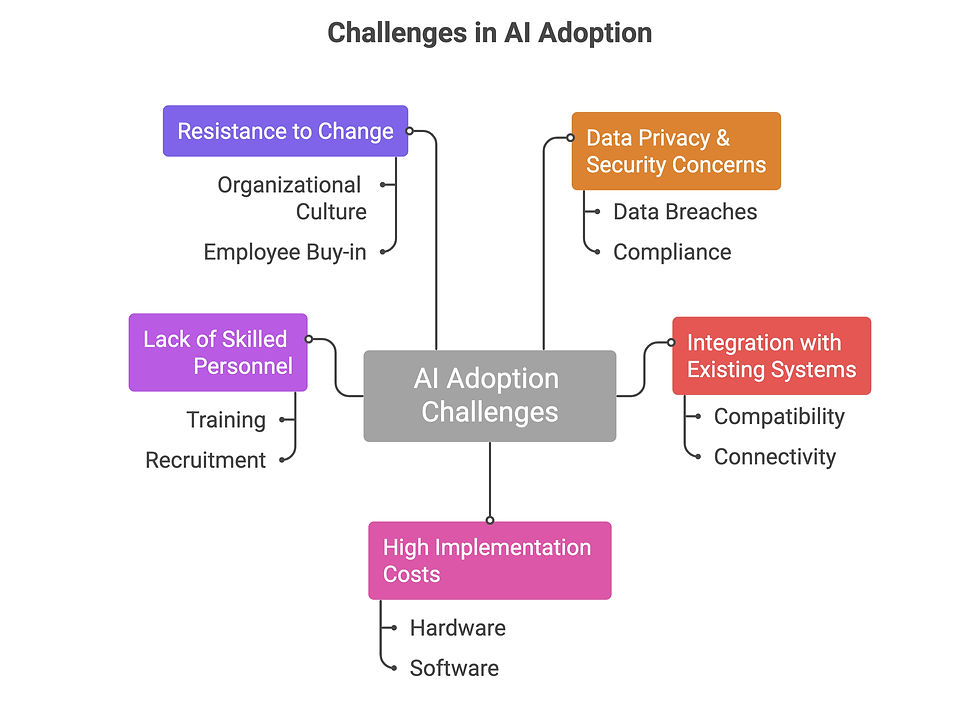
What Gets in the Way
The barriers to AI adoption are real. Acknowledging them is not pessimism, it is the first step to addressing them.
Barrier | What This Means in Practice |
Data quality | AI models are only as good as the data they are trained on. Fragmented CRMs, inconsistent tagging, and poor data hygiene limit what AI can reliably produce. |
Integration complexity | Most organisations run multiple disconnected tools. Getting AI to work across systems requires either investment in integration or a willingness to consolidate. |
Skill gaps | Many marketing and sales teams do not yet have in-house capability to implement or manage AI tools effectively. The technology is advancing faster than most internal training programmes. |
Change resistance | AI changes how work gets done. Teams that feel their roles are being automated rather than augmented will resist adoption. Implementation without change management typically underperforms. |
Governance and risk | Automated decisions at scale carry risks — from compliance failures to biased outputs. Organisations need oversight frameworks before they scale AI into customer-facing functions. |
Real-World Evidence
AI's commercial impact is not theoretical. The evidence is accumulating across sectors.
Financial Services
Retail banks with AI-powered CRM systems have improved lead conversion rates significantly by shifting from scheduled outreach to behaviour-triggered engagement. When contact is based on what a customer actually does, rather than when a call centre has capacity, conversion improves and customer experience improves with it.
E-commerce
Personalisation engines that adjust product recommendations in real time based on browsing behaviour consistently lift average order values. The mechanism is simple: show people what they are most likely to want, when they are most likely to buy it.
Healthcare
Private healthcare providers using AI for patient communication, appointment reminders, follow-up sequences, post-treatment engagement, are seeing measurable improvements in both patient retention and net promoter scores. The operational efficiency gains are secondary to the trust-building effect.

How to Build the Foundation
Organisations that are seeing results from AI did not start by choosing a tool. They started by identifying a problem.
The implementation path that works:
Stage | Focus |
1. Identify the commercial problem | Where is speed, personalisation, or data analysis currently limiting performance? Start there. |
2. Audit your data | AI requires clean, structured, accessible data. Know what you have before selecting a tool. |
3. Start narrow | Pilot in one function or one workflow. Generate evidence. Build confidence before scaling. |
4. Build internal capability | Identify who will own AI outputs and decisions. Tools without accountable humans produce unreliable results. |
5. Measure what matters | Define success before you start. Revenue impact, conversion rates, customer retention, not just usage metrics. |
6. Iterate | AI tools improve with use. The first version is not the ceiling. Build feedback loops into the process from day one. |
The Commercial Reality
AI does not create revenue by itself. It creates the conditions for commercial teams to perform at a level that was previously impossible.
The companies that will benefit most are not necessarily the largest or the most technically advanced. They are the ones that are clearest about the problem they are trying to solve, realistic about what their current data and infrastructure can support, and disciplined about measuring commercial outcomes rather than technical outputs.
The revenue engine is being redefined. The question is whether your organisation is building the right engine, or still optimising the old one.


Comments